
Strengthening a flood warning system in four steps: How one council used a collaborative approach to develop a roadmap to resilience

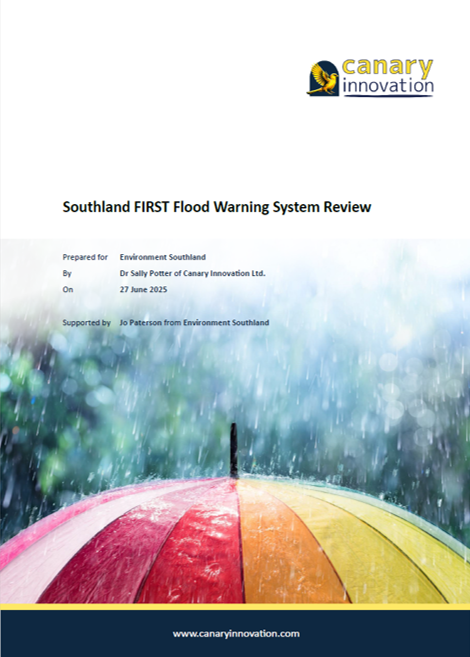
Flooding remains one of the most significant natural hazards facing communities in Aotearoa New Zealand. In a recent project with Environment Southland, we collaboratively evaluated their flood warning system to identify priorities and next steps as they work towards an impact-based warning system.
We devised an innovative four-step process for this evaluation to develop a roadmap towards community flood resilience – this post outlines how we did it.

Please reach out if you would like to discuss how we could tailor this approach to support your communities with improved warning systems too.
Project background
The project was initiated by Southland Council’s Flood Impacts & Risk Specialist Team (FIRST) Readiness Group in late 2024. The desired long-term impact was that:
‘Community resilience to floods is enabled, empowered, and supported by FIRST through connected agencies and effective communication of risks’.
The project involved four key activities:
Evaluating each aspect of the warning value cycle through a workshop series with a wide range of partners and stakeholders, and identifying and prioritising next steps
Facilitating a self-assessment of the FIRST team’s current understanding of the warning value cycle and various roles within it, and providing training material to support improvements
Engaging with at-risk communities, and increasing partnerships with mana whenua and the National Emergency Management Agency
Reviewing examples of previous flood warning messages and recommending improvements.

This post focusses on the four-step process we used to evaluate the warning value cycle (activity 1 above). There is more information about the ideal content for flood warning messages (activity 4 above) in this previous blog post here.
Environment Southland’s project lead was Jo Paterson, and it was conducted in partnership with Tracey Fraser and Oliver Todd from Emergency Management Southland, and Angie Hopkinson from Te Ao Marama.

The four-step evaluation approach
Step 1: Identify who should be involved, how, and when
Our first step was to identify who should be involved in the project, and how and when they are best engaged. This included:
At-risk communities (such as the rural community of Otautau)
Community leaders
Mana whenua Emergency Facilitator and Te Ao Marama representatives (from the local Māori indigenous population)
Welfare agencies that could reflect the needs of people with disabilities and minorities in the community, animal welfare, etc.
Local government
Emergency services
Industry and infrastructure stakeholders
Communication specialists
River engineers and hydrologists
Emergency management governance.

Step 2: Develop a checklist and rating system
We used a checklist of 110 parameters developed by the World Meteorological Organization (2018), which span across the four pillars of a multi-hazard early warning system:
Risk knowledge
Detection, monitoring, analysis, and forecasting
Warning dissemination and communication
Preparedness and response capabilities.
Each of the parameters are quite detailed. Here are some examples:

The rating system we devised has three levels to reflect the current level of achievement for each of the parameters:

Step 3: Collaboratively evaluate the current status of the warning system
Each of the parameters were collaboratively assessed in a series of workshops involving the relevant sectors and communities listed in Step 1. We used the rating system and checklist to determine the current status of Southland’s warning system around the whole warning value cycle.

A heatmap highlighted where the gaps were identified across the four pillars.
The context was described by the participants for each parameter, such as recent achievements or current relevant programmes taking place. Approximately 190 next steps were also brainstormed by these participants in the workshops.
Step 4: Prioritise the next steps
The next steps were prioritised by a FIRST leadership group from Environment Southland. We devised a method where each step was rated for their degree of difficulty and the impact that could be achieved if the step was completed.
This was then converted into a long list sorted into order of priority, and a matrix.
Key findings and impacts
The review identified priority areas for improvement. These included:
Strengthening risk knowledge, especially for vulnerable communities and assets
Improving coordination and clarity of roles across agencies
Enhancing communication strategies, particularly for minority and at-risk groups
Updating standard operating procedures (SOPs)
Increasing inclusion of iwi perspectives and community insights in flood intelligence workflows.
The detailed and prioritised next steps are in a report held by Environment Southland. They include items from improving hazard maps to updating contact lists, and tailoring education campaigns to coordinating multi-hazard warnings.
The project team at Environment Southland are now engaging with the Coordinating Executive Group and integrating the next steps into their workplans and budgeting processes.
We will also be reflecting on the methodology used and determining how we can refine this internationally relevant tool further for the New Zealand context.
This review emphasises the need for a holistic, inclusive, and collaborative approach to flood warning systems. It provides a roadmap for enhancing Southland’s warning system, focusing on community engagement, interdisciplinary collaboration, and the integration of technical and indigenous knowledge.
By addressing identified gaps and implementing prioritised next steps, Southland can improve its flood resilience and ensure timely, actionable warnings for all its communities.
Interested in discussing this approach further?
If your council or Emergency Management Group is looking to strengthen its flood warning capabilities, please reach out.
Together we can explore how a tailored evaluation can support your community’s resilience.
References
World Meteorological Organization (2018). Multi-hazard early warning systems: A checklist. World Meteorological Organization (WMO), 20 pp., https://library.wmo.int/viewer/55893?medianame=MHEW_030918-08_#page=1&viewer=picture&o=bookmarks&n=0&q=


Comments